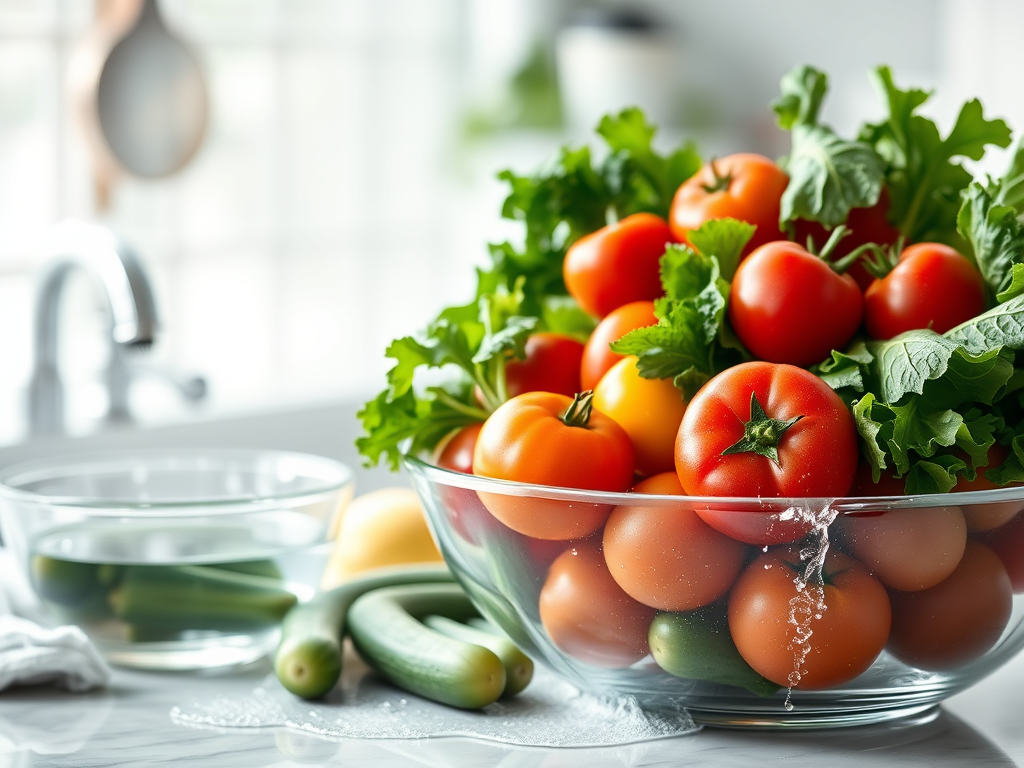
Properly washing your fruits and vegetables is a crucial step in food safety that many home cooks overlook. The CDC estimates that unwashed produce contributes to a significant portion of foodborne illnesses each year, making effective cleaning techniques essential for your family’s health.
To detox farm produce before cooking, you can use the following methods:
- Cold Water Rinse: Start by rinsing your produce under cold, running water to remove dirt and some surface bacteria.
- Vinegar Wash: Soak your produce in a solution of 1 part vinegar to 3 parts water for 5-10 minutes, then rinse thoroughly.
- Baking Soda Solution: Mix 0.84g of baking soda per 100ml of water and soak your produce for a few minutes to reduce bacteria.
- Hydrogen Peroxide: For a more thorough clean, soak your produce in a 1:1 solution of hydrogen peroxide and water for 1-2 minutes, then rinse.
- Homemade Wash: You can create your own wash using ingredients like apple cider vinegar or other natural substances to effectively remove pesticides and contaminants. These methods will help ensure your produce is clean and safe to eat before cooking.
Highly hazardous pesticides are defined by the Food and Agriculture Organization of the United Nations (FAO)/World Health Organization (WHO) International Code of Conduct on Pesticide Management (2014)1 as pesticides that are acknowledged to present particularly high levels of acute or chronic hazards to health or environment according to internationally accepted classification systems such as WHO or GHS [the Globally Harmonized System of Classification
and Labelling of Chemicals] or their listing in relevant binding international agreements or conventions. In addition, pesticides that appear to cause severe or irreversible harm to health or the environment under conditions of use in a country may be considered to be and treated as highly hazardous.
- can be very toxic to humans.
For example, a fourth of a teaspoon
of carbofuran or monocrotophos
active ingredients can cause death
if ingested; - are primarily, but not only, older
generation, off-patent chemicals
still readily available and in use
in many low – and middle – in
come countries, even when less
hazardous alternatives have already been authorized - cannot be used safely in low –
and middle – income countries
where suitable Personal Protective
Equipment (PPE) for protection
against highly hazardous pesticides
is not available or not used because
it is too expensive or too uncom
fortable to wear. - have been phased out from agri
culture in a number of countries
without affecting agricultural pro
ductivity; - are one of the most common
means of suicide worldwide, ac
counting for 15-20 percent of all
suicides2; - can be found in local food sys
tems and global food commodi
Wear gloves Wear eye protection Wea
ties such as bananas, coffee and
rice, but the most contaminated
crops are fruit and vegetables.
 DoctorPanie
Leave a comment